Whether you operate a fast-growing e-commerce brand in Johannesburg, a high-volume manufacturing plant in Durban, or a retail chain across the Western Cape, securing a reliable supply of plastic bags for packaging is essential for daily business operations.
As South Africa’s packaging landscape evolves rapidly, businesses are facing a double challenge: the need for durable, cost-effective logistics protection, and the pressure to comply with strict new environmental laws.
Here is everything you need to know about the current market trends, regulatory shifts, and how to choose the right plastic bags for packaging for your South African business.
Why Plastic Bags for Packaging Dominate the South African Market
Despite the rise of alternative materials, industrial and retail sectors across South Africa continue to rely heavily on plastic-based solutions. According to recent market data, the South African plastic packaging sector is valued at over $2.7 billion (USD), driven by several practical, economic, and operational advantages:
Cost-Effectiveness: Compared to cardboard or glass, plastic bags offer the lowest manufacturing and transport costs per unit, protecting tight commercial margins.
High Tensile Strength: High-Density Polyethylene (HDPE) and Low-Density Polyethylene (LDPE) are engineered to withstand rough transit conditions without tearing.
Moisture and Dust Protection: Essential for the agricultural, construction, and food sectors to preserve perishable goods and materials across diverse climate zones.
- Customizability: Modern manufacturing allows for specialized form factors like gusseted bags for bulky goods, zipper seals for healthcare, and branded retail carry bags.
Key Market Segments Using Plastic Bags for Packaging
The industrial demand for high-quality packaging bags spans multiple major growth sectors in South Africa:
Industrial Demand
Agriculture (20% Growth: Moisture-proof, durable transport bags)
Manufacturing (22% Growth: Heavy-duty custom product covers)
Logistics & E-Commerce (15% Growth: High-volume, lightweight courier mailers)
Construction (18% Growth: Heavy-duty material bags)
Regulatory Compliance: Navigating PCR and EPR Targets
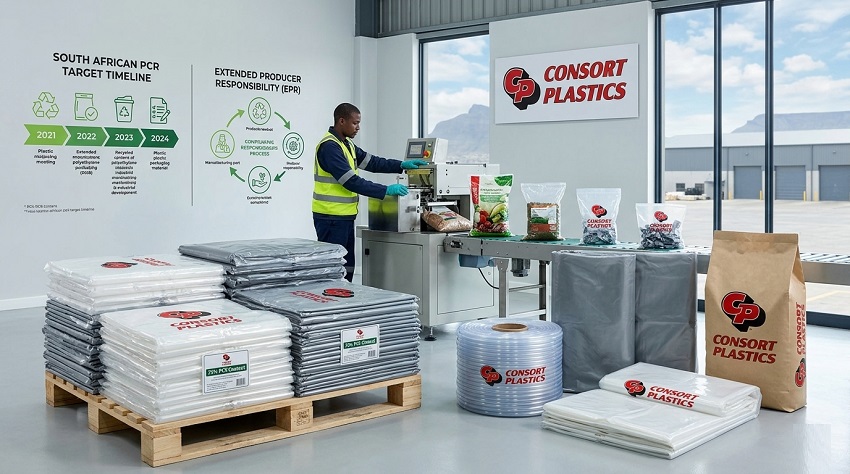
If you are buying or manufacturing plastic bags for packaging in South Africa, compliance is no longer optional. The Department of Forestry, Fisheries and the Environment (DFFE) handles plastic bags through an aggressive circular economy strategy.
1. Post-Consumer Recyclate (PCR) Mandates
To tackle long-term landfill waste, national regulations mandate that all plastic carrier bags and flat bags must feature high percentages of recycled plastic waste.
| Regulatory Milestone | Required Minimum PCR Content | Compliance Status |
|---|---|---|
| January 2023 | 50% Recycled Content | Fully Implemented |
| January 2025 | 75% Recycled Content | Current Legal Standard |
| January 2027 | 100% Recycled Content | Upcoming Target |
Additionally, standard commercial bags must maintain a minimum thickness of 24 microns to ensure durability and facilitate multiple reuses before entering the recycling stream.
2. The SA Plastics Pact 2030 Targets
The circular economy shifted gears significantly with the official launch of the SA Plastics Pact 2030 targets. Supported by major local retailers (Pick n Pay, Woolworths, Spar) and top manufacturing bodies, members have committed to an actionable structural shift:
- A 20% intensity reduction in virgin fossil-fuel-based packaging. cbn.co.za
- Ensuring 70% of flexible plastic packaging is fully designed for practical recycling. cbn.co.za
- Achieving a 55% actual output recycling rate for all plastic packaging streams.
3. Extended Producer Responsibility (EPR)
Under South African EPR laws, any brand owner, manufacturer, or importer who introduces more than 10 tonnes of plastic packaging into the domestic market annually must financially contribute to a Producer Responsibility Organisation (PRO). These fees directly fund the collection, sorting, and processing infrastructure required to keep plastic out of local environments.
How to Choose the Right Plastic Bags for Packaging for Your Business
To ensure your supply chain remains both efficient and compliant, use this quick checklist when sourcing materials from local South African plastic manufacturers:
- Verify Recycled Content Certification: Ensure your supplier can provide clear documentation verifying that your bags meet the current 75% PCR legal threshold.
- Match Material to Function: Use HDPE for high-strength, crinkly bags (ideal for heavy retail items or basic grocery bags) and LDPE for high-clarity, smooth, puncture-resistant packaging (perfect for boutique apparel or industrial liners).
- Design for Recyclability: Avoid mixed-material layers or heavily dyed plastics that complicate the recycling process downstream. Stick to mono-PE materials where possible.
The Bottom Line
The phrase “plastic bags for packaging“ is no longer synonymous with single-use waste. By embracing local circular economy frameworks, your business can protect its bottom line while supporting a sustainable, job-creating recycling sector right here in South Africa.
Want to look closer at Extended Producer Responsibility (EPR) compliance in SA?
Comments are closed
Contact Us

ForRental
26 Capsicum Ave
Marlboro Gardens, Sandton, 2063
Cell Phone: +27 642463678
info@digitalmarketingpta.co.za
https://www.forrental.co.za
Send us Mail